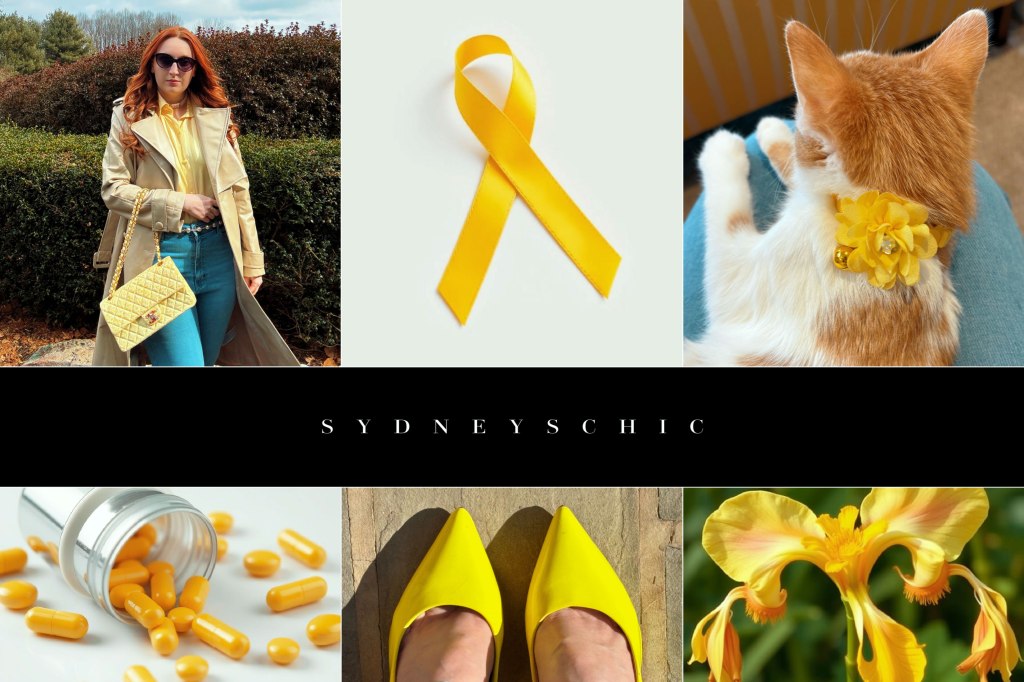

This week’s post is going to be a bit different. We’re not going to be talking much fashion or styling—anything fun, really—but we are going to be talking about Endometriosis awareness and why those of us struggling with it and our loved ones wear yellow. If you are sensitive to this type of topic, that’s fine and I will see you next week! This one is definitely not for the faint of heart though regardless of if you stay, be sure to check out other lighter Endo facts on my instagram and spread awareness! Just because there’s no cure now doesn’t mean that there won’t be one someday if we get loud enough.
I have debated writing this post for at least the past couple of months because it is a deeply personal subject to not only me but also my family since this disease is often hereditary. Rather than get too specific about my health concerns, I often simply refer to my autoimmune conditions in their entirety rather their individuality. Though I have posted about Endo awareness before on my socials, I have never gone into detail about my battle with this illness or the toll that it has taken on my life. Only those who know me quite well personally have been privy to the gory details but in a world where we’re no further ahead in finding a cure than we were when my mother was suffering and no one seems to care, I think it’s time that we get a little louder about the reality we live with.
I would feel like a hypocrite for posting about awareness if I didn’t share my own story but more than that, my dearest friend was recently diagnosed within the past few years after numerous health scares. This friend means the world to me and she has been closest to my heart like a sister. One of the first things we talked about when she disclosed her diagnosis was how isolating of a condition endo is and how alone you feel in your pain. So I’ll write about my journey for her and every other girl out there like just like us whose suffered in silence or suffered alone thinking they were losing their mind because science hasn’t caught up with them yet. If sharing our experiences helps other sufferers feel seen or validated, that’s the next best gift to a cure that we can give. Not to mention, many women suffer with this condition but never get help because of how long it takes to be diagnosed or their pain has been normalized. The more we talk about it, the more we help them too. You’re not crazy girl, your uterus is.
What is Endometriosis
This disease was first discovered in 1860 by Karl von Rokitansky, an Austrian pathologist, when he observed endometrial tissue outside the uterus in other areas and organs. It was not until the early 1900’s that the condition was fully recognized and given the name “endometriosis”. Unfortunately since then, not much progress has been made in treatment because of the complexity of the disease though the most common way to manage it is with surgery and birth control methods but many symptoms unfortunately remain a part of daily life. Many famous women have also suffered with this condition such as; Marilyn Monroe, Daisy Ridley, Halsey, Whoopi Goldberg, Susan Sarandon, and queen of country herself, Dolly Parton. I think we should just start calling it the hot girl curse at this point but maybe I’m a bit biased.
Endometriosis is a condition where tissue similar to the lining of the uterus—the endometrium—grows outside of the uterus. This misplaced tissue can implant on other organs in the pelvic and torso areas, such as the ovaries, fallopian tubes, stomach, bowel, and bladder. It’s important to keep in mind that this tissue travels throughout the entire body and has been found in every organ and part of the body, not just the torso—Endo has even been found in topical organs such as the brain. I make this point because I think it’s a mistake to classify it as simply a “reproductive” or “female health” condition when it affects the entire body and in my opinion, operates more like an inflammatory or autoimmune disease. By classifying it as a female health problem, it’s thrown into the corner to gather dust because who cares, right? If it’s classification was changed, I wonder if more research and treatments could become available but that’s just my say having lived with this debilitating condition for over 15 years now—what do I know? I got news for everyone: if it’s a “women’s” health problem, it’s everyone’s health problem because we are the birthers of the world. If it affects us, it affects you.
Just like the uterine lining, this endometrial tissue thickens, breaks down, and bleeds with each menstrual cycle. However, because it’s outside the uterus, it has no way to exit the body. This can lead to inflammation, scarring, pain, and sometimes infertility. The severity of endometriosis can vary greatly from person to person, and its symptoms can significantly impact a woman’s quality of life. This has lead to an increase in mental health problems in women suffering from this condition and even led to suicide. Such was the unacceptably tragic cases of Trinity Graves and many others to whom I also dedicate this post—we have to do better. Most women will require multiple surgeries to treat this disease throughout their lifetime—each with their own set of potential dangers and complications. These surgery usually consist of cutting out or burning the Endo growing outside the uterus to stop it from growing on other organs or further spreading. While the exact cause of endometriosis is still unknown, several theories exist, and research continues to explore this complex condition.
Quick facts
Here are some statistics to think about: 1 in 10 women have Endometritis. An estimated 200 million women worldwide suffer with Endo. On average, it takes around 7-11 years to actually be diagnosed with Endo—which usually can only be done with surgery such as a laparoscopy. In 2018, Endo was one of the most googled health searches. Endometrosis has been linked to many autoimmune diseases such as: Systemic lupus erythematosus (SLE), Sjögren’s syndrome, Rheumatoid arthritis (RA), Crohn’s disease (CLD), multiple sclerosis (MS), inflammatory bowel disease (IBD), and other conditions specifically related to inflammation. As I mentioned above, though Endometriosis is not listed as an autoimmune condition itself, further research is being done to see if it should be and in my opinion, it definitely should!
Available data shows that 50-60% of women suffering from this disease go undiagnosed and simply endure the pain thinking it’s benign or normal cramping. They are also shamed into silence because it can an uncomfortable topic to discuss with others. It’s a well known fact that many doctors either misdiagnosis or dismiss Endo patients. They have been accused of being crazy or imagining their pain because of it’s complexity as a disease—gaslighting is so much easier than addressing the problem, right? Historically speaking, the medical community has not been kind and understanding of Endo patients. We have been marginalized and misbelieved. Between 50% and 80% of women with pelvic pain have Endo. The National Health Service has listed Endometriosis as one of the most painful health conditions a human can have. Scientific studies have shown that Endometriosis pain can be as painful as a heart attack. As a result of their pain, women with Endometriosis have a four times greater risk of chronic opioid use compared to women without it. Because of the addictive nature of certain pain medications and the risks associated with them, many women are denied adequate pain medication by their health care providers and must simply make due with whatever they have like over the counter pain relievers not meant to tackle such severe pain. My favorite is when they recommend the heating pad like it’s Oxycodone—top tier medical assistance!
I have been told by my doctor that research suggests women with hereditary Endometriosis start with symptoms younger or sooner depending on how many generations the disease has been in the family. I would say this is probably true because my mother and grandmother both seemed to start having their symptoms much later than myself in their late teens to early twenties while mine began at around twelve or thirteen and by the time that I was twenty and had my first surgery, my doctor was horrified to find that my Endo stage was advanced enough to be found in a forty year old patient, not a twenty year old. So, I give credence to this theory from my own family’s personal experience. My grand mother was still able to have 3 young healthy children in her early 20’s before she became sick but I couldn’t even get to my sweet sixteen before the weight of chronic pain was crushing me and my mother thought I might die.
Endometrosis is not currently classified as a lethal disease in health care and the amount of causes that actually result in death are low however in some circumstances, complications from endometriosis, like bowel obstruction, ruptured cysts, endometrial tissue growing into the intestines or fallopian tubes which can also cause blockages or ruptures, severe bleeding, and ectopic pregnancies, can become life-threatening if left untreated so I would argue that it does kill—just more quietly and insidiously.
My diagnosis
My story with endo begins long before I ever had my first cramp or before I was ever even born but I’ll condense it because I’m merciful. My mother struggled with Endometritis and it was one of the reasons she decided to specialize in Obstetric medicine and female health when she began her nursing career. Several unsuccessful treatments, failed pregnancies, and botched surgeries later, she was finally able to have me at 40 years young after a long road of pain, infertility, mistreatment, malpractice, and being misunderstood even among her own medical peers. Further into her career when she was getting her doctoral degree, her focus would be on genetics and more personalized health care rather than a “one size fits all model.” Needless to say, there aren’t words to express how proud I am of her for not only her achievements, but the care she provided to women especially at a time when it was such an underdeveloped field.
Growing up, I always knew that my mother was strong but I never realized how strong she was until I got old enough to start with my first endometriosis symptoms. In all fairness, I have always been frail of health my entire life so at first, I shrugged a lot of my more mild pain off and went about my business. That worked until I felt too sick to even get out of bed and go to school anymore. Once walking between classes had been a breeze and then suddenly I was doubled over dreading the walk up hill to go home. I went from a seasoned competing equestrian to struggling to get the mail. As I gradually got worse, I began attending high school online because of many different factors but the main one was my health. It was lonely and kind of miserable but I was thankful to not have to try and physically pull myself together every morning. I missed the major mile stones like prom, getting my driver’s license, and graduation because by the time I was sixteen, I was barely able to function. For me, it was severe abdominal pain that made me wish for death and constant heavy bleeding that I couldn’t get to stop. People were noticing and constantly pointing out that I looked different but rather than being compassionate, they were painfully judgmental about my appearance. The most popular rumor being spread about me was that I had an eating disorder but I didn’t, I either couldn’t keep my food down because of the pain or had lost my appetite entirely due to depression. Who wants to eat when they feel like they’re dying? Now I shrug off their arrogance but at the time, it was devastating.
Paralyzed with pain, moving was unbearable and even breathing hurt. I lost so much blood at different times that I was severely anemic and frail. I developed a anxiety disorders because I never knew when the pain would hit and how long it would last. I was getting weaker and nothing I took helped with the constant pain which started off only lasting a couple of days at a time and gradually increased until I was never painless. Because Endo can only be diagnosed through surgery, many doctors were reluctant to treat me for Endometriosis despite my family history and I felt too young to undergo that kind of procedure. My grandfather was dying of cancer at this time and I didn’t want any more stress on my family nor did I want to lose any time that I had left with him so I chose to wait and tried to manage it as best I could with what they were willing to prescribe me and over the counter medications for pain. For anyone wondering, I don’t regret this decision at all and I would do it all over again.
The medication I got was able to help with my uncontrollable bleeding but it was so intense that I had to take more than the average amount to stop it. This led to drastic weight gain and I went from a size 0 to a size 12 in 6 months—not something I was very happy about though at least I didn’t look emaciated anymore. Then I started getting the opposite jokes—now I didn’t have an eating disorder, I was eating too much! It’s worth mentioning that while I’ve never had an eating disorder, I did suffer from temporary body dysmorphia because of how quickly my body changed on me. No one prepared me for the side affects of my medication and downplayed everything like I would barely notice. By the time I was 20, I was sick of doctors and ready for them to just cut me open and get it over with so that’s what I did. I don’t know what they gave me but before they took me back, I was ready to marry my handsome anesthesiologist and I still hope to find him in my next life—hopefully under happier circumstances!
My surgery was supposed to be 30 minutes and turned out to be 2 hours. Not only did my doctor find the Endometriosis that she needed for an official diagnosis but she found enough Endo in my body to match the advanced stage of a 40 year old woman. She burned as much endometriosis out of my torso as she could but made sure to mention that it was impossible to have removed it all. My doctor was also distressed to find one of my ovaries was fused to a pelvic ligament which was limiting my movement and making everything particularly painful. I didn’t have the heart to tell her that I had been jumping horses like that for the last two years eating pain relivers like candy and that I’d even taken a fall. I wasn’t reckless, I just refused to give up one more thing I loved because my body was betraying me. My mother is still in disbelief to this day about how I was able to do it and upset about the risk it was to my safety but again, I don’t regret it. I kept the bulk of my pain to myself and I did the best I could to have a life but towards the end of my riding career, even spectators could tell when I was having a bad day and would point it out. My instructor drilled me harder and no matter how hard I tried to compensate, I just couldn’t. Now after my surgery, we all knew why.
I owe everything to Dr. Ellis. She was the first doctor who actually helped me and it took me way longer than it should’ve to find a care provider capable of compassionate treatment. After my surgery, she retired and I started a new medication that was the answer to my prayers! Oh, the weight fell off and my quality of life came back. For a few years, I was doing alright! I felt like a person again! There was only one problem—this medication is not safe to be on indefinitely as it can cause bone issues and damage to the cardiovascular system. I was on it longer than I should’ve been but it was just so nice to have a life. Suddenly I thought about college and a future I hadn’t thought about since before I got so sick and that was hard to give up. I was hopeful that the next medication that I was prescribed would be just as helpful but it wasn’t. It’s better than my very first medication, but it does very little for discomfort which I still live with daily. I’ve been able to attend college classes on enough pain medication to put down an elephant but at least it’s progress so I will take my win, thank you!
I prefer the medication that I’m on because it has less side affects than the first one I was on but it does cause me to have other side affects I hadn’t had before like; chest pain, shortness of breath, vertigo, nausea, and dizziness spells that have just become apart of me now. It makes certain things difficult sometimes like stairs which I avoid when I can and I have shied away from driving since the car has become a major source of motion sickness. Sometimes my vision blurs and I can’t leave the house without Dramamine in my purse but believe it or not, these side affects are still better than my original ones. Isn’t that sad? I’d rather have vertigo than hopeless depression and I’ll take a touch of nausea over progressive bone degeneration. This is the unfortunate reality of being chronically ill. You have to pick and choose what you feel you can manage and while I’m hopeful for more positive changes, this treatment is the closest I’ve gotten to feeling like myself—albeit a very seasick version. Even on my worst day, I’m doing better than I was and I just take it one day at a time proud that I’m able to fool most of the world into thinking there’s nothing wrong with me.
Endo Awareness
Having Endometriosis has changed my entire life from the way that I dress to the way that I approach challenges I once would’ve welcomed with open arms. It is a merciless disease that has not only attacked me but generations of women in my family. Despite the advances we’ve made in modern medicine, treatments and cures remain elusive and it causes me worry for not only the future generations of my family but others as well. Many people have not even heard of this disease and if they have, aren’t aware of how damaging and dangerous it really is to try and coexist with.
I could honestly write so much more and maybe I will in the future but more than anything, I hope this was informational. If you have endo, you are not alone and if you know someone who has it but didn’t understand their pain, you can now. These are not just “cramps” and it’s not just a “period thing”, it’s a terrible, awful disease and I plead for compassion. To anyone whose ever made fun of me or spread rumors about me because of my diagnosis, just know you made fun of a very sick woman but I forgive you—I may think you’re stupid but I forgive you.
I would also like to take a moment and acknowledge any other sufferers of chronic illness outside of endo because your battle is difficult too and we all stand together. It doesn’t matter what your illness is or where it comes from, we are all under this umbrella together. Please continue to support others in their health challenges because they are some of the most difficult ones to face.
Your health matters—continue to take care of yourself and prioritize it. Your know your body best so don’t let yourself be gaslit or ignored. Your pain is real and so are your feelings. Stay healthy and stay hopeful!
Extended Content
Endometriosis featured on MDTV
Endometriosis featured on the Today Show

make sure you subscribe & follow to be notified of new content
©sydneyschic ┊image credit: sydneyschic ┊unsponsored post









 Sydney's Chic.
Tell me what you think!