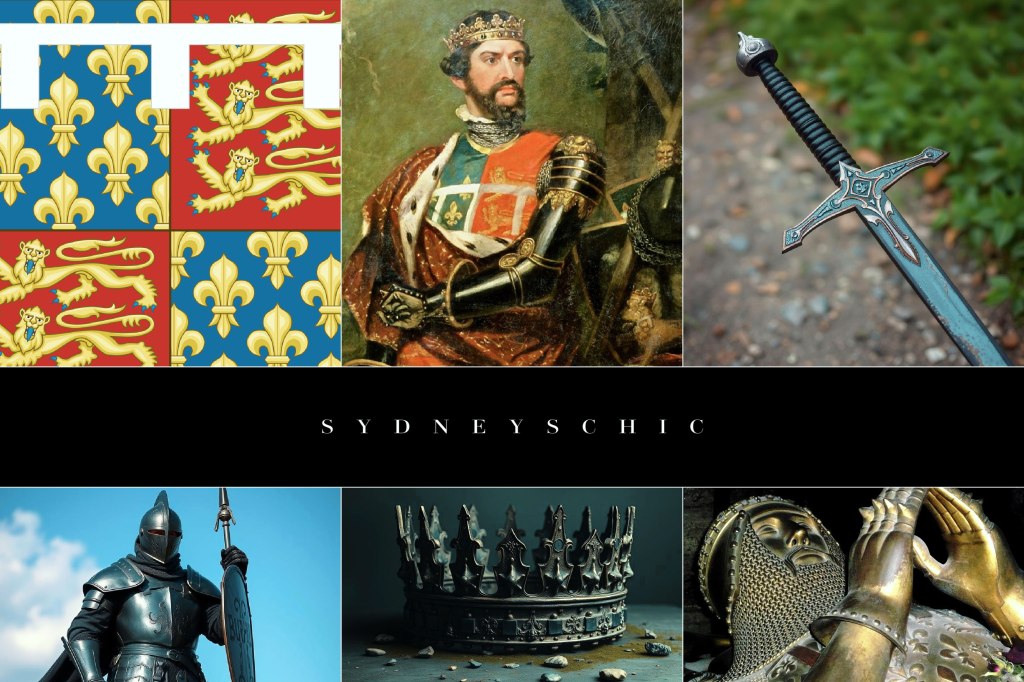

In this week’s Haute History post, I thought that I would write about a historical figure whose caught my interest recently and has been as much of a style icon in death as he was in life. Many historians believe that the 14th century was pivotal to fashion as something more purposeful and ornate rather than simply practical to throw on and it’s this time period that our hero emerged. It’s also worth mentioning that during this time, the line between fashionable dress and military dress was virtually non existent meaning that there was a huge emphasis on a soldier’s position as more than just a rank they held but also a physical aesthetic they lived.
We’re riding into the medieval world of knights and chivalry so go grab your armor! We’ll be discussing the life and glorious feats of Edward of Woodstock—better known to history as the Black Prince—as well as the iconic look that earned him his name. To this day, he is still considered to be one of the greatest knights in history and the most skilled knight of his age. He has also remained one of the most popular and admired heirs to the English throne in history though he’d tragically never get a chance to wear the crown and would forever remain simply an heir.
We have touched on heraldic fashion before in some previous posts—specifically the ones featuring the baroque trend, but this one will be a little different because we will be talking about the actual heraldry and symbolism of this prince and how it’s still so impactful over 600 years after his death. Like it did back in the days of Edward, our fashion and what we wear can speak to many things about us from our mood and our interests to our goals. It’s this beautiful mixing and matching of personal individual symbolism that has always fascinated me about heraldic aesthetics but we’ll get there, I promise! First, we need to understand how Edward’s story began.
Heir to the throne
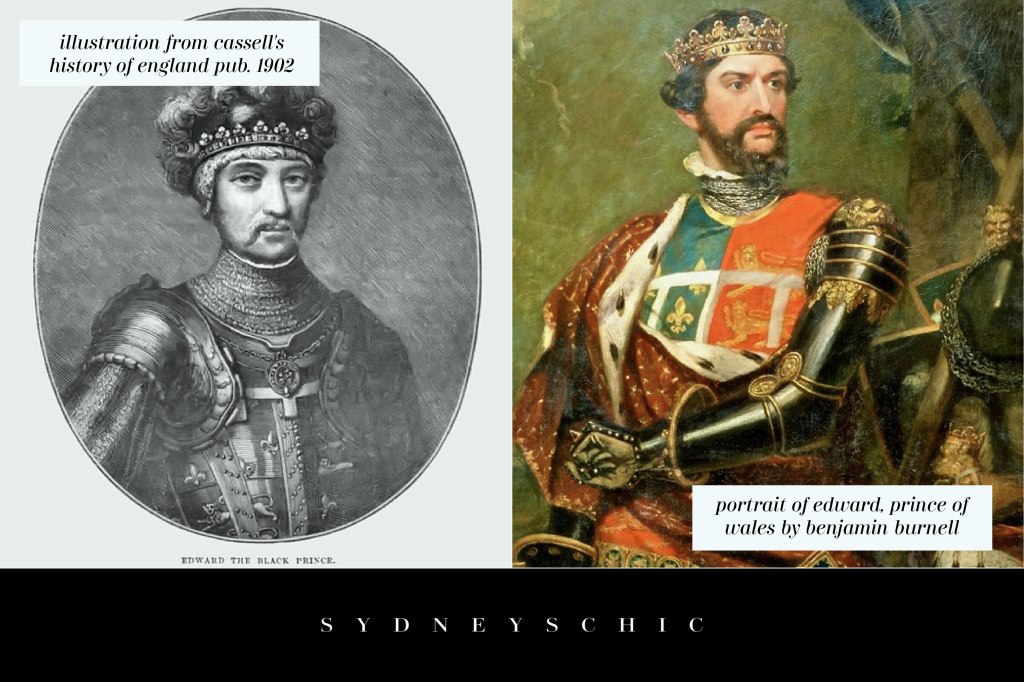
Prince Edward of Woodstock was born on June 15th, 1330, in the Woodstock Palace that he would take his nickname from as a way to differentiate between himself and his father and namesake, King Edward III of England. His mother was Queen Philippa of Hainault and the royal dynasty that he was born into were the Plantagenets. His parents would go on to welcome several children after him but would also lose many during the Black Death. They were thought to have had at least twelve sons and daughters—nine of whom survived infancy to reach adulthood.
At the time of his birth, England and France were embroiled in a bitter feud and spiraling quickly towards the Hundred Year’s War. King Edward was not only arguing his rights over the English lands in France but also his claim to the French throne through his mother—Prince Edward’s grandmother—Queen Isabella, the she wolf of France. Though she had been Queen of England, Isabella’s strong ties to her homeland as well as her status as a daughter of King Philip IV of France put her sons and their sons in both the French and English lines of successions. To keep things simple, as is the case of many needless wars, it was two countries bickering over the same piece of real estate—good thing we don’t do that anymore! It’s a joke, calm down. I watch the news.
As eldest, Edward was heir to the throne and his early life was steeped in privilege and royal expectation. From a young age, it was clear that Edward was being groomed for leadership and military command. He received a comprehensive education, learning Latin, French, and English, alongside subjects like arithmetic and theology. More importantly, his training focused heavily on martial skills: horsemanship, swordsmanship, and the art of warfare were all central to his upbringing, preparing him for the role of a future warrior-king. The young prince’s life wasn’t solely confined to study and combat; he was also introduced to courtly life, participating in tournaments and ceremonial events, fostering the image of a chivalrous and powerful future leader.
Throughout his youth, Edward was already gaining titles. He was first given an earldom before being created Duke of Cornwall and presented with a duchy. This would be the earliest instance of a dukedom in English court and it’s title would stay closely associated with all of the heirs to the throne for hundreds of years up until modern times. While his moniker, “The Black Prince” emerged possibly due to his black armor or ruthless reputation, his official titles reflected his lineage and the authority he wielded. He was Prince of Wales, a title traditionally given to the heir apparent of the English throne, a position he held from 1343 until his death. The title of Prince of Aquitaine, granted to him by his father, King Edward III, placed him in charge of a significant portion of English controlled French territory. These titles showcased his importance within the English monarchy and his strategic role in the ongoing conflicts with France, highlighting a life defined by both royal privilege and military prowess.
Edward married his childhood sweetheart, Joan of Kent, in October 1361, despite his parents viewing the match unfavorably. Joan, a recent widow and former ward of the Queen had been in Edward’s sights for years as he’d gifted her a silver cup that he’d won from one of his very first military campaigns. Their marriage was considered a rare love match in a court of orchestrated alliances and political climbers. Historical records suggest Edward loved her all his life and some of his passionate letters to her have survived the centuries to prove it. He was also three or four years younger than her—which means that there was some couglary a foot but no actual cradle snatchery! Their marriage would give Edward two sons; Richard II of England and Edward of Angoulême. Though not the main cause, his death would play a key factor in the future War of the Roses fought between the York and Lancaster cadet branches of House Plantagenet. Edward’s early demise and failure to ascend to the throne would cause a power vacuum that would span decades and leave his house teetering on the abyss until the death of the last Plantagenet ruler, King Richard III, in 1485 at the Battle of Bosworth.
The greatest knight
Edward of Woodstock, the Black Prince, remains a figure of legendary prowess in medieval military history. His victories on the battlefield were not merely tactical triumphs, but demonstrations of strategic brilliance and personal courage that cemented his reputation as a fearsome warrior throughout Europe. His first campaign was at sixteen and at the Battle of Crécy in 1346, despite being just a teenager, he commanded the front line. He played a pivotal role in the overwhelming English victory, showcasing his early aptitude for leadership and battlefield command.
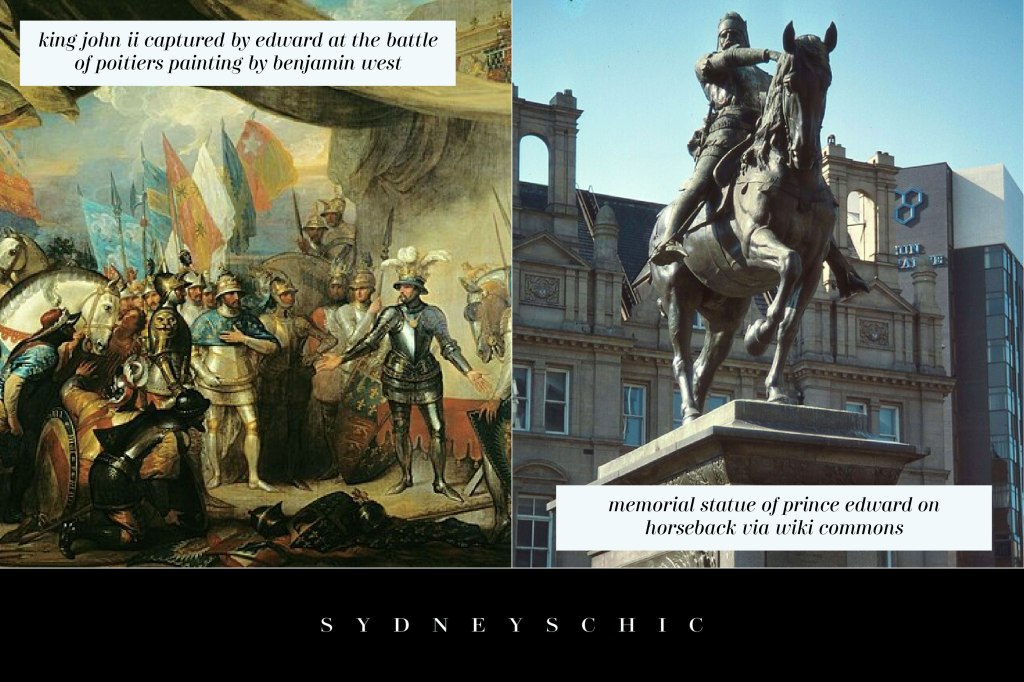
Edward’s subsequent triumph at the Battle of Poitiers in 1356, where he decisively defeated a much larger French force and captured King John II of France, stands as perhaps his most celebrated achievement—a testament to his innovative tactics and the discipline of his English army. The Black Prince’s victories were not just isolated events; they were instrumental in shaping the course of the Hundred Years’ War and solidifying English dominance in France for a significant period that would survive him well after his death.
The prince’s final years saw a decline in his health and a shift away from active campaigning. His last major military undertaking was his involvement in the Castilian Civil War in the late 1360s. He successfully restored Peter of Castile to the throne, securing a victory at the Battle of Nájera in 1367. However, this triumph proved costly. The Black Prince contracted an illness—probably dysentery—during the campaign, and Peter of Castile failed to reimburse him for his expenses. This financial strain, coupled with his deteriorating health, effectively marked the end of his significant military achievements. Although he continued to hold positions of authority and influence, his days of leading troops into battle were largely over.
Edward returned to England in 1371 after his last major campaign and he continued to be involved in politics and other activities before succumbing to illness. He died on June 8, 1376, at the Palace of Westminster much to the shock and grief of the English people who loved him. Had he survived another year, he would’ve been able to take the crown from his ailing father, King Edward III but instead his son would be made king. In Edward, the people had high hopes that he would make a magnificent king and they eagerly awaited his ascension that would never come. During his lifetime, he was viewed as one of the most accomplished defenders of his realm who quickly brought enemies of England to heel and his death brought safety and uncertainty. In the hearts of the English people, he was and still remains a national hero.
While he was feared by his enemies, Edward was also a figure who inspired great respect among them. The French, particularly, viewed him with a mixture of dread and grudging admiration. His devastating raids and battlefield victories earned him a reputation for ruthlessness and strategic brilliance. To them, he was a symbol of English aggression and the embodiment of the brutal chevauchée tactic, leaving a trail of destruction in its wake. Yet, they also understood his battlefield acumen and tactical expertise, recognizing him as a formidable opponent whose wins were hard-earned and meticulously planned. His perceived cruelty, whether real or exaggerated by propaganda, further solidified his image as a fearsome and dangerous foe in the eyes of those who opposed him.
Slaying style icon
Edward epitomized the ideal of chivalry and knightly skill in the 14th century both in how he dressed and how he carried himself. As a knight, Edward adhered to the strict code of honor, displaying loyalty to his king and country, demonstrating compassion towards those deemed worthy, and exhibiting ruthlessness towards his enemies on the battlefield. His black armor became a symbol of his intimidating presence, and his victories, cemented his legacy as one of the most formidable knights of his era, embodying the very essence of medieval knighthood. Even during his lifetime, he was already a style icon easily spotted in a crowd and he knew this. The first person he brought with him upon his return to the English court was his personal tailor because priorities, am I right?
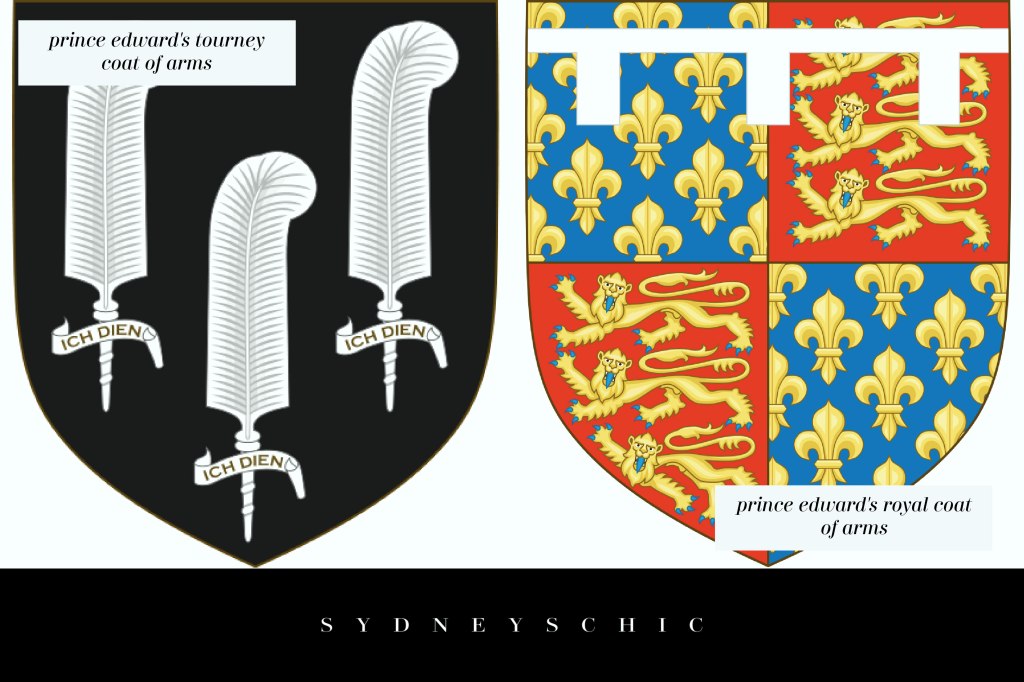
While the exact origin of his “Black Prince” name is still debated by modern historians—most attribute it to his black shield and potentially the color of his armor as it became inextricably linked to his fearsome reputation as a warrior. His armor, likely not uniformly black but perhaps featuring dark elements, details, and embellishments, would have been meticulously crafted not just for protection but also to project power and prestige. The heraldic symbols displayed on his surcoat, shield, and horse trappings, such as the three ostrich feathers and the motto “Ich Dien” (I serve), adopted from the Bohemian king and linked to the Prince of Wales, served to reinforce his royal lineage and military tact. Essentially, his armor and heraldry weren’t simply functional; they were carefully curated tools to communicate his identity, status, and the formidable force he represented on the battlefield.
Textiles were a lot more relevant to medieval armor than it’s usually given credit for because it’s the metal pieces that have been best preserved to history. Padded textiles were actually the most important aspect of protection for soldiers as it was too early for armorers to incorporate big pieces of iron and steel in the 14th century. We tend to think of the chain mail and metal plating but beneath all of that was a blend of thick fibers such as sheep’s fleece, raw linen, and cotton sewn inside of a tunic for extra padding to be worn beneath the rest of the armor. On safer ceremonial occasions, a simple silk surcoat or tunic without the padding would’ve been worn instead but the heraldry would’ve remained the same.
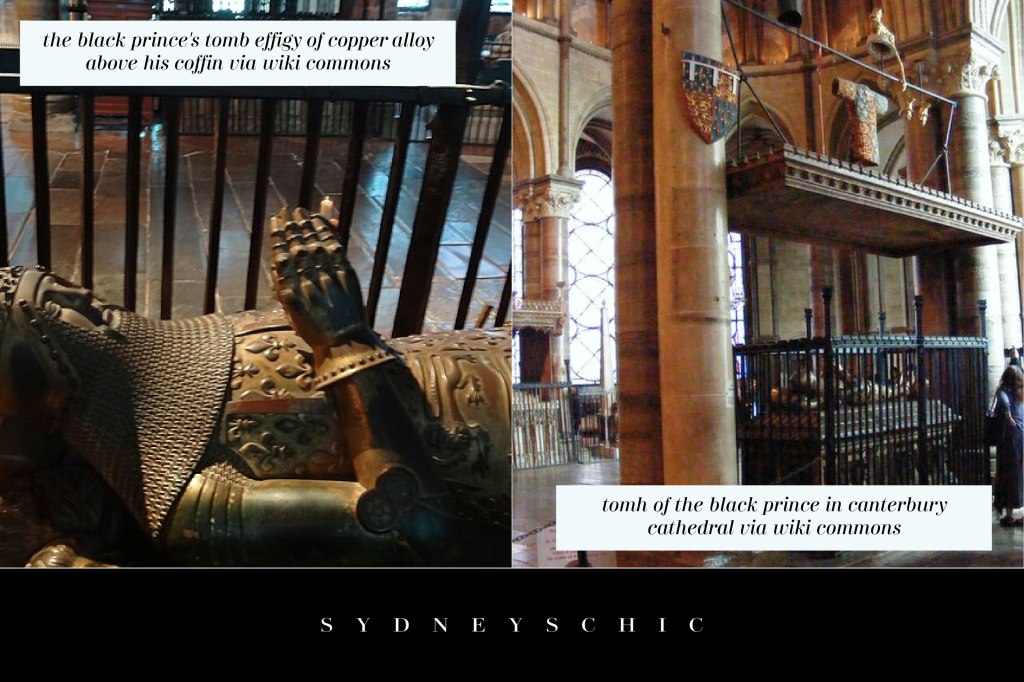
Today the Black Prince rests in Canterbury Cathedral—his tomb a powerful testament to extraordinary life and enduring legacy. Surrounding his life like effigy of gilt copper alloy are several of his personal knightly possessions, deliberately placed to showcase his chivalric ideals, martial accomplishments, and undying devotion to his realm in accordance with his last wishes. Most notably displayed are his surcoat, helmet, gauntlets, shield, and sword. These are not exact replicas, but rather the original—albeit heavily restored—artifacts he would have used in battle. Their presence, preserved for centuries and allows visitors to connect directly with the Black Prince, imagining him in the thick of battle, upholding the code of honor that defined the medieval knightly class. They serve as tangible reminders of mortality as well as the legend Edward cultivated. There’s something tragically beautiful about a knight so dedicated to his kingdom and people that he wanted to be laid to rest as if he were still ready to defend it at his king’s command. Edward wanted to be immortalized as a defender of his people and country long after his duty ended and the clutches of death had grabbed him. This kind of allegiance makes me heartbroken that he never lived long enough to be king himself and was a sentiment mourned by his subjects.
Modern Heraldry
Heraldic symbolism, once the exclusive domain of noble houses and powerful families, is seeing a fascinating resurgence in modern fashion—particularly in the 1980’s and 1990’s alongside the baroque trend which features many of the same elements. Designers are drawing inspiration from the rich visual language of coats of arms, incorporating elements like crests, charges (symbols within the shield), and tinctures (colors) into their designs. This isn’t just about slapping a random logo on a garment; rather, it’s a deliberate choice to imbue clothing with a sense of individuality, tradition, and even a touch of rebellion. Bold lions on bomber jackets like they just leapt out of a tapestry, intricate golden threaded fleurs de lis adorning handbags, and carefully chosen color palettes echoing family sigils are all ways heraldic symbolism is being translated for a contemporary audience.
The appeal lies in the inherent storytelling capacity of heraldry as well as it’s eye catching hues. Each symbol carried a specific meaning, representing virtues, achievements, or affiliations. When these symbols are integrated into fashion, they offer a way for wearers to express a sense of identity, whether it’s a personal connection to history, particular region, or a desire to project an image of strength and sophistication. Having your own personal heraldry can not only be impowering but fun! There are thousands of symbols to choose from representing all goals and walks of life—not to mention, they’re an interesting conversation starter for anyone paying close enough attention! There’s sentimental symbols that I often wear myself and they aren’t been missed as a calling card by those closest to me.
While some designers directly adapt historical heraldic imagery—with many fashion houses having their own crests as alternative logos—others reinterpret and reimagine these symbols, creating new narratives and injecting a sense of modernity into ancient motifs. This fusion of tradition and innovation makes heraldic symbolism a compelling and increasingly relevant trend in the ever-evolving world of fashion that can be expressed in the bright fabric of a shirt reminiscent of knightly banners or quietly in the intricate metalwork of a ring band. As it has for hundreds of years, heraldry remains one of the most iconic and traditional trends to survive into the modern age. Once a crown prince met with a tragically, untimely death, Edward of Woodstock lives on as a style icon who did literally slay. Rest fashionably, Edward.

make sure you subscribe & follow to be notified of new content
©sydneyschic ┊image credit: sydneyschic ┊unsponsored post
Additional sources for the images used in my post:
Illustration of Edward, the Black Prince via Cassell’s History of England – Century Edition – published circa 1902 on the left side.
Portrait of Edward of Woodstock, Prince of Wales by Benjamin Burnell on the right side.
King John II of France captured by Prince Edward at the Battle of Poitiers painting by Benjamin West on the left side.
Memorial statue of Prince Edward on horseback via Philip Halling on Wiki Commons on the right side.
The Black Prince’s tomb effigy of copper alloy above his coffin via Jonathan Cardy on Wiki Commons on the left side.
Tomb of the Black Prince via Gordon Griffiths on Wiki Commons on the right side.








 Sydney's Chic.
Tell me what you think!