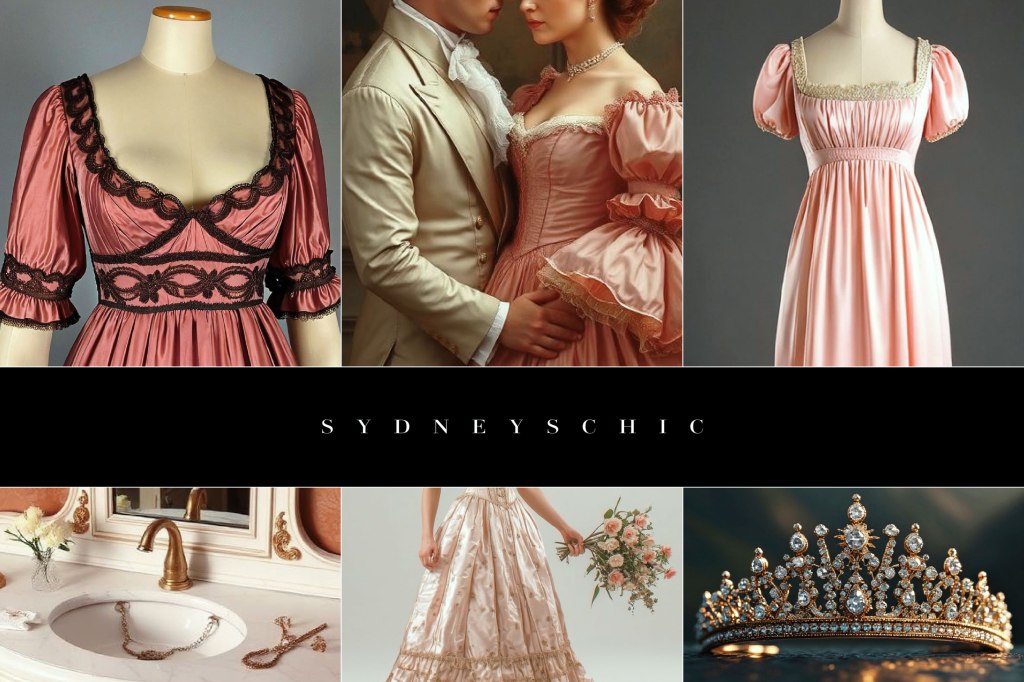

The Regency era continues to inspire modern fashion ever since it’s birth on the world stage over 200 years ago. It still pulses through contemporary wardrobes with its elegant silhouettes and refined color palettes resurfacing in every runway from London to New York well after it’s progenitors have long passed into the pages of history books. The period’s visual romance was first cemented by the painter, Sir Thomas Lawrence (1769–1830), whose luminous portraits of aristocratic ladies in empire waist gowns, delicate muslins and sky blue shawls turned the era’s style into an idealized vision of grace, restraint, and high society.
Perhaps the most significant revival of Regency fashion took place in the 1990’s with the return of empire waisted dresses frequently featuring in top fashion magazines and on rising super models. Designers in the 90s—most notably Alexander McQueen, Vivienne Westwood and John Galliano—picked up this sophisticated tableau, reinterpreting the long dried brushstrokes of painters such as Lawrence into wearable puffed sleeves, exaggerated ruffles and bold, pastel toned tailoring that echoed the Regency’s delicate balance of austerity, simplicity, and opulence.
Today, the influence is evident in popular media and beyond with the reoccurring resurgence of high waistlines, delicate drapery, and an emphasis on soft accessories such as period inspired gloves, ribbons, and cameo jewelry, proving that the refined elegance of the early 19th century court remains a timeless source of inspiration. Whether you see these trends hanging from the walls of an old stately home or playing out on a movie screen right before your very eyes, the Regency aesthetic lives and breathes both in art and in culture.
If you’re wondering why we’re getting another history post so soon after the one on Empress Sisi of Austria, it’s because I was invited to attend a Bridgerton Ball last minute that benefits those suffering with food insecurity in my community. Obviously, I’m going, but before I share how I styled my look and created my costume in the next post, we need to know a little bit about Regency fashion! Given that I did had to do my own research for the purpose of accurate costuming anyway, it only made sense to share what I’ve uncovered with you all, my lovely readers! This is what we’ll be discussing in this week’s post so grab your tiara and a cup of tea!
Overview
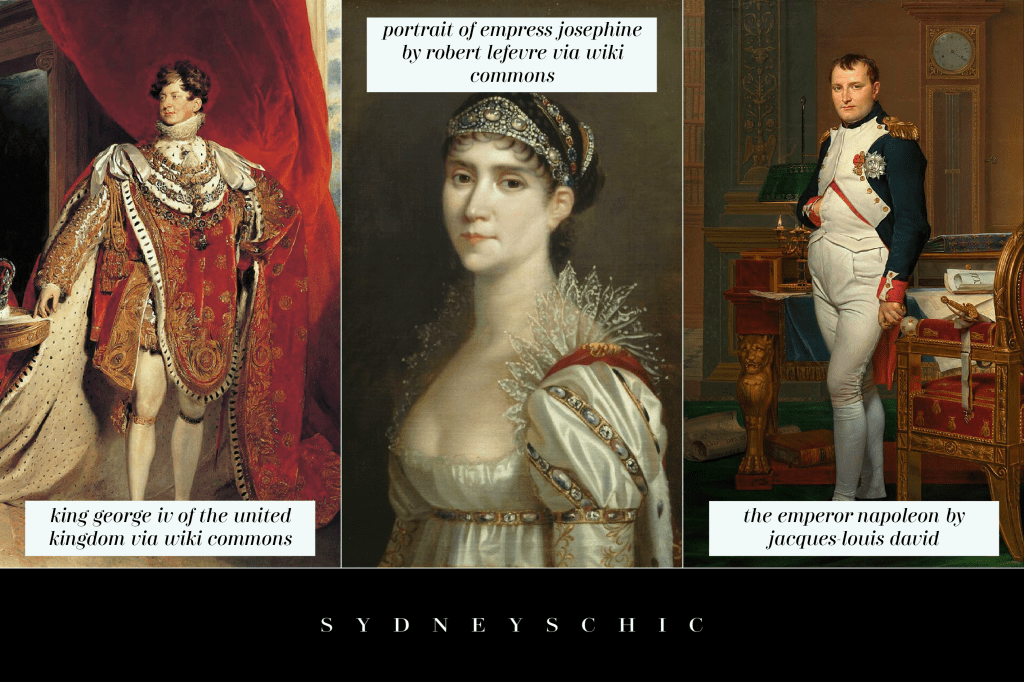
The Regency era (roughly 1795-1820), dominated by the sartorial reign of the fashion forward Prince Regent—later George IV of the United Kingdom and Hanover—marks a pivotal and elegant shift in Western dress, moving decisively away from the ornate, wide silhouetted styles of the late 18th century toward a streamlined, classical ideal often found in ancient works of art. Inspired by the archaeological discoveries of Pompeii and Herculaneum and the political fervor of the French Revolution, fashion embraced a new “Empire” silhouette for women: high, just below the bust waistlines, lightweight, columnar gowns in fine muslin or silk, and a focus on slender, upright figures often accentuated by spencer jackets and dramatic shawls.
For men, the era perfected the modern suit’s foundation: tailored, fitted coats with tails, waistcoats, and tight fitting pantaloons or breeches, emphasizing a clean, disciplined lines that signified respectability and social order. This period was not merely about aesthetics but a visual language of status, morality, and globalization, where the intricate details of a fichu, the height of a cravat, and the quality of one’s woolens communicated rank, political allegiance, and participation in a rapidly industrializing world.
It’s also worth noting that during the Napoleonic era (1793–1815), which falls within the Regency, French Emperor and strategic genius, Napoleon Bonaparte popularized the wearing of military uniforms among men as a symbol of patriotism, high fashion, and social status. No longer was wearing a uniform just for lowly foot soldiers, but rather an outfit of high society and wealth. His first wife, Empress Josephine, was also one of the most popular historical figures to be painted in the Regency style and is considered the quintessential face of the Regency period to many historians.
Inspiration
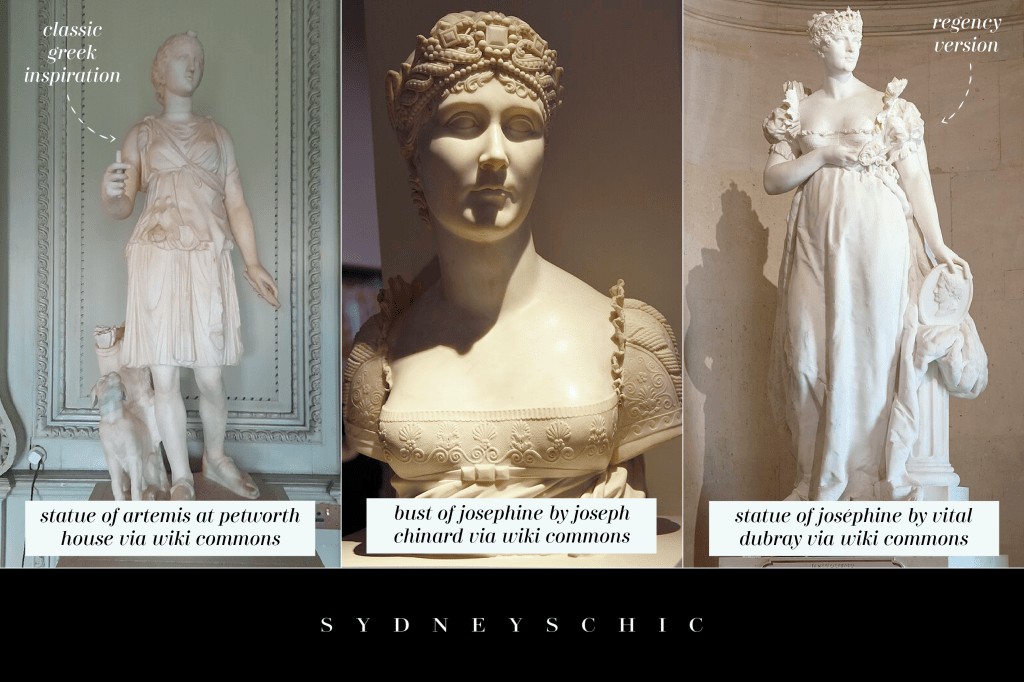
The Regency era’s wardrobe owed its most striking elements to a revived fascination with classical antiquity, a trend sparked by the Grand Tour, archaeological discoveries at sites like Pompeii and Herculaneum, and the neoclassical designs of architects such as Robert Adam. These influences manifested most famously in the empire silhouette, a high waisted, columnar dress that mimicked the draped robes of ancient Greek goddesses and the flowing tunics of Roman matrons, while fabrics were often light, sheer muslin that echoed the delicate linen of antiquity. More event appropriate formal choices for fabric were; silk, satin, taffeta, crepe, and soft velvet, to name a few.
Decorative motifs—Greek key borders, laurel wreaths, and mythological reliefs—adorned everything from waistcoats to gowns, and accessories such as diadem style hairbands, satiny sandals, and gilt edged fans reinforced the classical aesthetic. Tiaras were often rounded like those traditionally worn by Roman empresses or featured other accents reminiscent of ancient queens such as colored gemstones. Embroidery was frequently used throughout to blend a mix of ideas and symbolism into one cohesive garment with metallic thread. This included beading, sequins, or pearls sewn into the design as well.
Even men’s attire reflected the trend, with tailcoats cut to a sleek, Grecian line and military inspired epaulettes echoing the iconic armor of Roman legionaries. Short waisted coats with long tails accentuated a man’s height and made him look taller, yet refined. These coats were also made of intentional textures and fabrics meant to proclaim power from afar not unlike the garb of senators from Ancient Rome. In sum, Regency fashion was not merely a superficial pastiche; it was a conscious, stylish appropriation of classical ideals of beauty, proportion, and virtue, transmuted into the elegant, refined clothing that defined early 19th century high society. Each tailored line was met with a flowing softness or carefully affixed detail.
Classic Staples
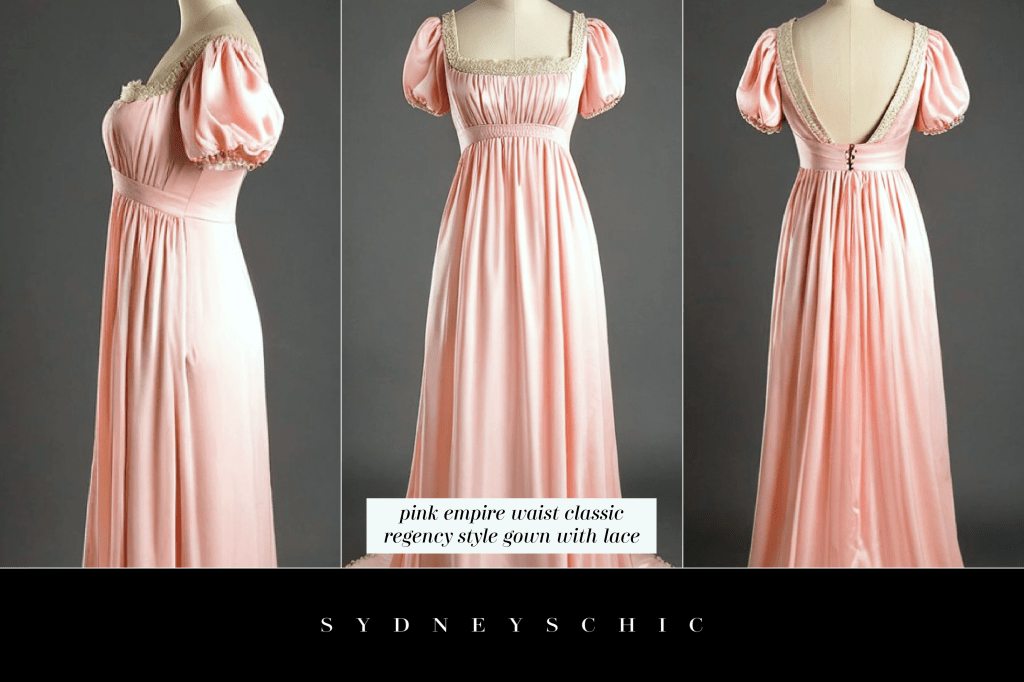
As mentioned above, the Regency period is known for using the empire waist as the signature of their fashion. This design directly channels the neoclassical fascination with ancient antiquity, deliberately echoing the draped, high waisted gowns seen on Greco Roman statues. It features a bodice that ends sharply just below the bust, creating a long, unbroken vertical line that serves as the foundation for the gown’s flowing, column like skirt. The seam at the base of this shortened bodice is often emphasized with a delicate detail—a narrow band of ribbon, a subtle line of embroidery, or a gathered band of fabric—which visually anchors the top to the skirt and defines the waistline’s precise placement. This strategic detail not only sharpens the silhouette but also provides a point of visual transition between the structured fit of the bodice and the gentle cascade of the skirt, perfectly encapsulating the era’s blend of classical inspiration and refined decorative artistry.
Regency dresses, whether intended for a leisurely promenade around the garden or an opulent society soirée, were distinguished by a deft interplay of fabric and ornamentation that signaled the wearer’s social standing and the occasion’s formality. Casual daywear favored lightweight, breathable materials such as muslin, cambric, and early silk blends—often printed with delicate floral motifs or striped in muted pastels—and was finished with modest trimmings like simple ribbon bows, modest lace caps, and unobtrusive passementerie. Formal evening attire demanded sumptuous, weighty textiles—silk satin, velvet, fine taffeta, and brocaded organza in deep jewel tones—adorned with elaborate detailing such as hand embroidered floral swags, gilt braid, metallic filigree, and lavish appliqué of pearl studded lace trim, all cinched at the waist by a jeweled or beaded sash that transformed the silhouette into the iconic high waisted, empire line silhouette prized by the era’s elite.
During this time, women’s outerwear combined sophistication with the era’s newfound emphasis on a streamlined silhouette. The spencer jacket emerged as the quintessential finishing piece for a fashionable lady’s wardrobe. Cut just above the waist like a modern bolero and often tailored from silk, satin, or fine wool, the spencer—originally a short, cropped coat fashioned from a military uniform—offered a snug, sleeved fit that prioritized the high waist of empire style gowns worn beneath while providing a modest layer against the chill of cool weather. Many of the same embellishments found on dresses were also used in the spencer jacket such as decorative braiding, gilt buttons, matching embroidery, or extravagant trimmings that allowed it to be paired with the day dress, with a riding habit for countryside excursions, to late night balls, or even over a simple chemise for informal gatherings. Because the Regency prized an unencumbered, columnar line up and down the body, the spencer’s tight tailoring and minimal length avoided the bulk of earlier full length coats, making it the preferred “outer dress” that balanced practicality with the graceful, understated refinement that defined the age’s women’s fashion.
In this period, women’s footwear mirrored the era’s elegant yet restrained aesthetic, favoring delicate construction, modest height, and polished ornamentation. Ballet flats are often worn with regency costumes and while they’re not entirely authentic to the time as we will discuss, they are a great choice for a modern substitute if you’re working with a budget or you already have them in your closet. Historically speaking, the most common style was the low heeled, closed toe shoe—often called a “Regency slipper”—crafted from soft, finely creased calfskin or silk and finished with a modest, curved heel no higher than two inches. Buttons, ribbons, or ornate metallic buckles adorned the front of the shoe, while a narrow silk lined vamp revealed only a sliver of scandalous ankle, complementing the high waisted dresses and spencer jackets. The slippers of the Regency were almost the exact opposite of the undisguised luxuriant women’s shoes that had trended in the previous decades during the Rococo era.
For outdoor occasions like horseback riding, fox hunting, or other sports, sturdy leather riding boots with a slightly higher heel and a turned down toe were worn. Much sturdier and taller than the pairs of slippers worn in every day life, these boots were meant to provide more support and protection to the wearer in their travels. The everyday outdoor shoe was a lace up half boot either made of leather or cotton depending on the climate. The tops of these boots were sometimes trimmed with a thin band of grosgrain or lace for both design and comfort. The season and weather dictated daily shoe choice: soft indoor slippers with delicate heels, laced outdoor half boots, or tall riding boots each symmetrical and complimentary of the Regency aesthetic in their own individual ways. Throughout, the emphasis remained on graceful lines and subtle embellishment, allowing the shoes to uphold the gentle poise of Regency femininity without competing with the lavish drapery of the dresses or other garments themselves.
Jewelry Box
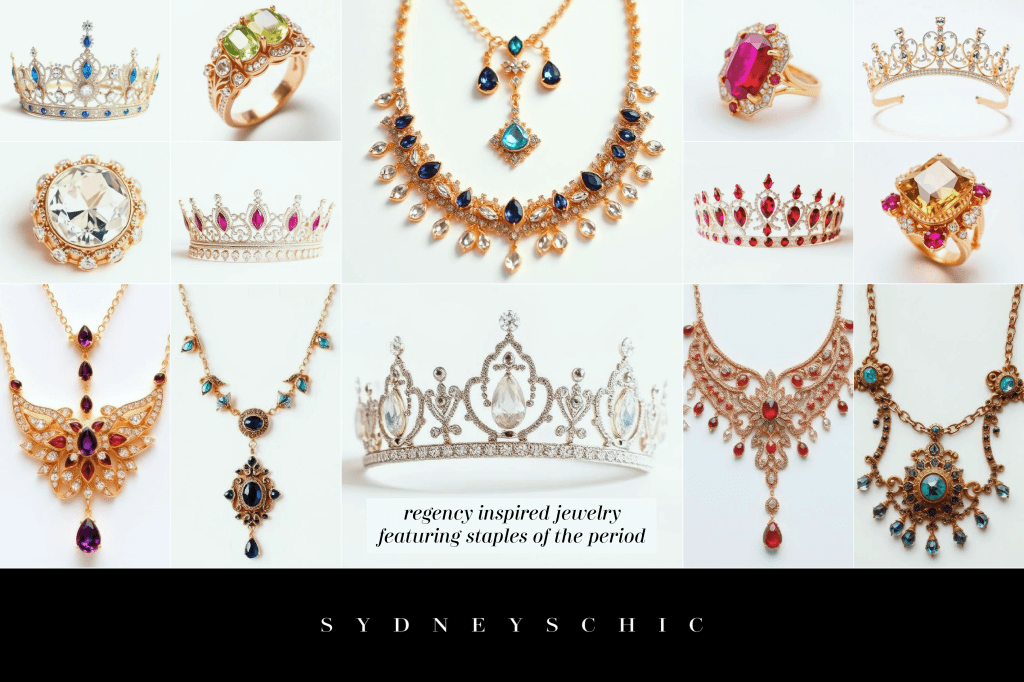
Regency jewelry, flourishing in the early 19th‑century European courts, is distinguished by a delicate blend of classical elegance and sentimental charm, expressed through a repertoire of recurring detail elements. Thin, filigreed gold or silver settings often cradle pastel colored gemstones—particularly rose cut diamonds, peridot, citrine, aquamarines, and soft hued amethyst—while enamel work in muted neoclassical motifs—such as laurel wreaths, swags of jasmine, and miniature urns—adds a painterly finish. Classic gemstones such as ruby, sapphire, garnet, emerald, and pearls have always been worn by the upper classes and they were still favored by the older aristocrats at court for their enduring prestige.
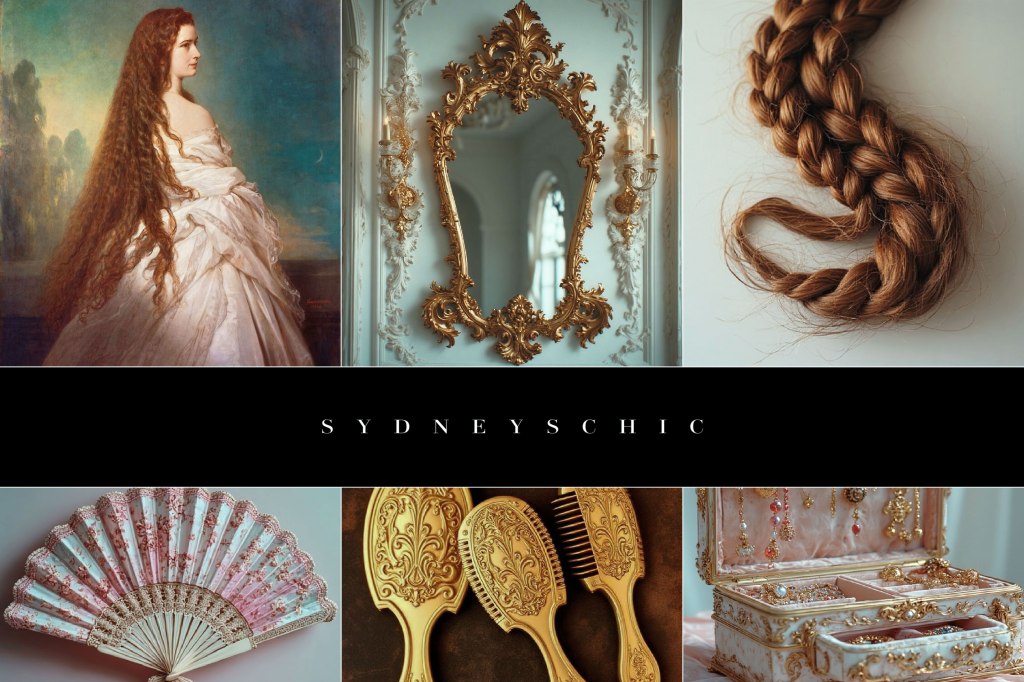
Miniature portrait pendants or locket rings, set in oval or shield shaped cases, capture loved ones in a whisper thin silvered glass, and the ever present cameo, carved from shell or coral, features mythological or pastoral scenes rendered in low relief. A hallmark of the period is the use of “hairwork,” where strands of a beloved’s hair are braided into intricate scrolls or woven into lockets, often encircled by beaded borders of jet or onyx. These elements, combined with the era’s penchant for asymmetrical compositions and restrained gilt over silver techniques, give Regency jewelry its signature refinement—simultaneously a showcase of technical virtuosity and an intimate record of personal sentiment.
Brooches, worn predominantly during the English Regency and the broader Napoleonic era, are exquisite examples of early 19th century neoclassical elegance. These delicate adornments often featured intricate goldwork, including fine wire scrolls, cannetille (spiral wire), and delicate granulation. Popular motifs drew inspiration from ancient civilizations, depicting mythological figures, acanthus leaves, and scrolls, alongside symbols of love and mourning such as intertwined hands, serpents, and memorial portraits under glass. Materials were chosen for their delicate beauty—seed pearls, cameos, coral, and turquoise were set in low carat gold, creating pieces that were lighter and more subtle than the heavy jewelry of the previous Georgian era.
Often worn in clusters on the neckline of empire waist gowns or dangling at the throat from a simple ribbon collar, a Regency brooch was not merely decorative; it could convey romantic devotion, commemorate a lost loved one, or showcase a cherished memory in the form of a miniature portrait long before the age of photography, making it a poignant and fashionable artifact of an age captivated by both classical antiquity and intimate emotion. Brooches and lockets hold more significance than any other time in historical fashion because during the Regency, they often took the place of traditional engagement rings. Pins with hidden messages were frequently exchanged to signify a betrothal and were thought to be much more personal in nature than other jewelry.
Regency tiaras, with their delicate filigree and sparkling ornaments, epitomize the grandeur of 19th century British aristocracy, where the reign of George IV and the social whirl of the ton demanded both subtlety and splendor at once. Forged from fine silver, gold, or lightweight alloy and often set with sparkling gemstones—most popularly diamonds and pearls—the designs favored soft crescent shaped arches or modest flower motif clusters that perched lightly atop a lady’s coiffure rather than towering like the more ostentatious Victorian pieces that would follow in the future.
Influenced by the neoclassical revival and the pastel palette of Regency fashion, these tiaras were typically worn at balls, weddings, and portrait sittings, signaling a wearer’s high rank while conforming to the era’s emphasis on graceful restraint. Their enduring appeal today lies in the way they capture the nuanced balance of regality and delicacy that’s so deeply intertwined with the Regency’s social ethos. This makes them prized heirlooms for both collectors and historians alike as well as coveted inspirations for contemporary designers seeking a touch of historic romance. Much like they were in the 1800’s, tiaras are still frequently worn at modern weddings by the bride.
Hair styles
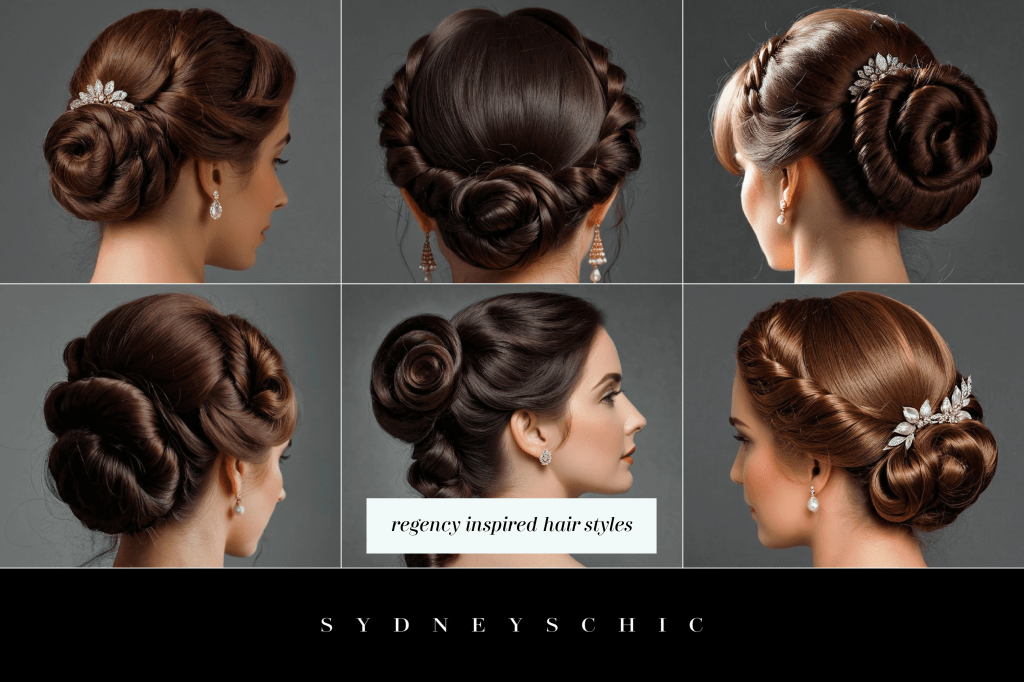
During the Regency, women’s hairstyles underwent a dramatic simplification, shedding the towering wigs and elaborate ornaments of the late 18th century in favor of a softer, “classical” aesthetic inspired by ancient Greece and Rome. The ideal look was one of natural, effortless grace, characterized by a center part with loose, artfully arranged curls or ringlets framing the face and a chignon or loose coil worn low at the nape of the neck. These styles, often called “à la Titus” after the Roman statesman, complemented the high waisted, columnar empire silhouettes of the gowns and short spencer jackets.
Day time decoration was minimal and understated with the focus on the healthy sheen of the hair itself, often dressed with pomade and powder for a fashionable ash blond or off white hue though this was more commonly found in lighter shades of hair where it appeared more natural. Accessories like sleek ribbon, strings of pearls, or a delicate comb were expertly woven into cascading coquettish locks for personality. This emphasis on simplicity and informality, so different from the preceding decades, reflected a new romantic spirit and a move toward more practical, mobile fashions, though the styles were often carefully constructed with padding and curling tongs to achieve their seemingly effortless appearance.
Formal evening coiffure was an intricate tableau of volume, texture, and ornamentation that signaled both social rank and fashionable acumen. Women typically gathered their hair high on the crown, creating a puffed base that was then wrapped in delicate curls, twists, or braids and secured with silk ribbons and decorative pins. The most celebrated silhouette was the “pavilion” or “tower” style, where a structured roll of hair rose like a miniature column, often reinforced with pads of horsehair or wire to achieve the desired height. To embellish this architectural framework, ladies draped their locks with satin or lace headbands, jeweled combs, jeweled or feathered hairnets, or sparkling tiaras, while a cascade of silk ribbons—sometimes dyed in pastel hues—was looped through the folds for added movement. Finishing touches included perfumed “hair powders” in soft shades of cream or rose, and a modest spray of scented water to keep the style supple throughout the night.
Altogether, Regency formal hair was a carefully curated blend of engineering and elegance, designed to complement the cascading gowns and the glittering chandeliers of aristocratic soirées. While lush, well coiffed hair was undeniably a central symbol of feminine beauty and social standing during this time, the period’s prevailing fashion often actively compromised hair health in pursuit of style. The ideal look featured high, structured curls and elaborate styles, achieved through daily use of heated irons, sticky pomades containing toxic substances like lead or mercury, and tight pins that could tug and break strands.
All of this was used in pursuit of “natural” beauty. Frequent washing with harsh soaps further stripped natural oils and depleted hair of much needed moisture. Thus, rather than prioritizing intrinsic health, society prized the appearance of abundant, glossy hair—a look meticulously constructed with damaging tools and products. The true priority was conformity to a demanding aesthetic that equated a meticulously arranged hairstyle with wealth, leisure, and virtue, even as the methods to achieve it weakened the hair it was meant to showcase.
Menswear Staples
The Regency is considered one of the most important periods in menswear history, as it serves as the foundation for modern, tailored menswear, the classic suit, and the concept of a refined, minimalist aesthetic for men. Pushed by the philosophy of “dandyism” popularized by male fashion icon and cricketer, George “Beau” Brummell, the era marked a dramatic shift away from the flamboyant, heavily decorated, and colorful fashions of the past 18th century toward a more understated, tailored, and masculine look. Before Brummell, men’s fashion was influenced by the French court at Versailles and had a feminine flair he sought to break away from.
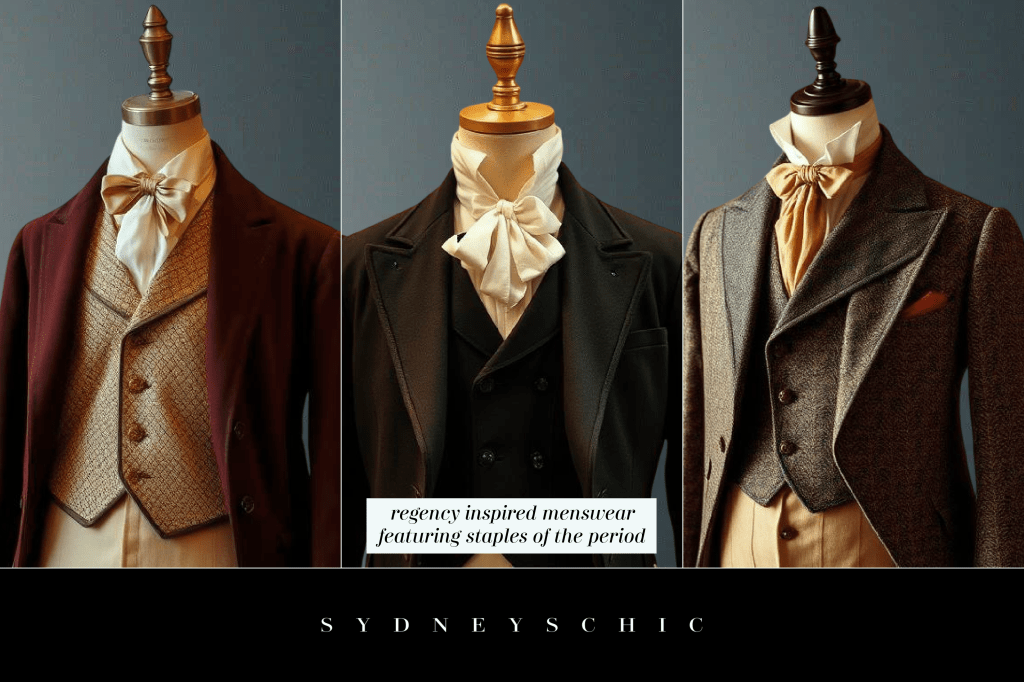
With Beau’s cultural influence marinating, menswear evolved into a sleek, understated sophisticate that mirrored the period’s fascination with antiquity and the rise of the modern gentleman that we recognize today. Tailors favored sharply cut, high waisted tailcoats in deep navy, charcoal, or rich russet, often trimmed with satin lapels and subtle gilt buttons, while waistcoats—typically single breasted and embroidered with faint motifs—added a flash of color under the sober exterior. Differing fabric textures and details were layered beneath the waist coat to enhance the neutral outer hue of the waist coat. The high waist of these tailcoats was a direct answer to compliment the empire waisted gowns worn by women. When these garments were worn together, it created the idyllic visual harmony synonymous with Regency romance.
Trousers, known as “pantaloons,” fell straight to the ankle, sometimes featuring a modest flare that hinted at the earlier flamboyance of the 1790s but retained a disciplined silhouette that didn’t betray the mission of masculinity. Tailors favored fabrics that combined elegance with endurance: fine wool for its subtle luster and resilience, silk twill for a fluid drape that caught the light, and lightweight cotton that offered breathability without sacrificing shape. Accessories including cravats tied in elaborate knots, silk top hats, polished calfskin boots, and understated pocket watches completed the look, heralding both the wearer’s social standing as well as his adherence to the period’s codified aesthetic of gentlemanly conduct.
A gentleman’s formal attire was a precise choreography of status and propriety—each element signaling rank and influence. The centerpiece was the cut away tailcoat with its sleek, waist length front and long, sweeping tails that brushed the floor, typically crafted from deep black or midnight blue wool and trimmed with silk satin facings. While there was some variation in color, it was always a dark neutral shade worn to stately evening events. Beneath it, a pristine white waistcoat—often embroidered in subtle silver or gold thread—added a flash of understated luxury, while a crisp, high collared shirt with a stiff starched cravat, hand tied into a graceful knot, framed the face.
Formal trousers were tight enough to reveal the curve of the calf yet modest enough to maintain decorum, were paired with polished, low heeled leather boots aimed to a mirror sheen by dutiful hands. Completing the ensemble, a silk top hat perched at a jaunty angle, a pair of white silk gloves rested on the lapels, and a pocket watch on a gold chain dangled from a finely cut waistcoat pocket. Each accessory was meticulously chosen to convey the wearer’s taste, wealth, and exacting standards of gentlemanly presentation. Like with women, brooches were also popular with men during the period who would wear stick pins, stock pins, and shirt buckles with gemstones for added color. Many of these brooches were used to fasten the shirt or decorate the neck cravat scarf.
Pop Culture
The modern influence of Regency fashion on pop culture is a palpable and stylish resurgence, largely ignited by the global phenomenon of Netflix’s Bridgerton among other leading period dramas. This isn’t merely a historical reenactment; it’s a vibrant, reinterpretation that blends the era’s signature elegance with contemporary sensibility. The aesthetic has seeped far beyond the screen, influencing red carpet fashion with its romantic, structured gowns, inspiring designers to incorporate corseted silhouettes and puff sleeves into ready to wear collections and fueling a social media trend of #RegencyCore. From high fashion runways to fast fashion storefronts, the language of Regency—with its emphasis on graceful drapery, intricate detailing, and a certain poised femininity—has been translated into a modern wardrobe vocabulary, proving that the early 19th century’s style codes possess a timeless, yet thoroughly adaptable, allure for today’s cultural landscape.
Regency fashion has perhaps been most immortalized by the brilliant literary work of classic author, Jane Austen, through her novels such as Pride and Prejudice and Sense and Sensibility, and the countless film adaptations that have followed, slipping beyond the confines of period pieces to become a subtle yet persistent undercurrent in contemporary style. Its hallmarks still echoing through everything from vintage shops to everyday streetwear at department stores. Even something as simple as wearing a dainty ribbon collar necklace is an homage to this bygone romantic era of mannerly courtships and high society.
With designers such as Dior and Alexander McQueen reinterpreting the empire cut dress and the Regency era chemise in modern fabrics, pairing the cinched waist with avant garde tailoring or luxe athleisure, while the resurgence of “soft romantic” aesthetics on social media—think billowing off the shoulder blouses, silk shawls, and low heeled slip shoes—directly references the genteel poise of Austen’s world. Even beyond clothing, the Regency influence pervades accessories: cameo brooches, slender pearl chokers, and miniature top hats have become popular “vintage inspired” accents, and the era’s emphasis on refined, restrained elegance informs the current preference for minimal, timeless pieces over overtly flashy trends.
In short, the Regency sensibility has been distilled into a modern trend of understated sophistication, proving that the this aesthetic still shapes how we dress, present ourselves, and even curate the visual narratives of our lives today over two centuries later.

make sure you subscribe & follow to be notified of new content
©sydneyschic ┊image credit: sydneyschic ┊unsponsored post





 Sydney's Chic.
Tell me what you think!